This is default featured slide 1 title

Go to Blogger edit html and find these sentences.Now replace these sentences with your own descriptions.

This is default featured slide 2 title

Go to Blogger edit html and find these sentences.Now replace these sentences with your own descriptions.

This is default featured slide 3 title

Go to Blogger edit html and find these sentences.Now replace these sentences with your own descriptions.

This is default featured slide 4 title

Go to Blogger edit html and find these sentences.Now replace these sentences with your own descriptions.

This is default featured slide 5 title

Go to Blogger edit html and find these sentences.Now replace these sentences with your own descriptions.

Saturday, June 30, 2012

Tibor Nagy

Replying to App Store reviews (Matt Gemmell):
Matt Gemmell:

Replying to App Store reviews  —  In the wake of the recent announcement that Google Play will allow developers to respond to user reviews of apps (Google Play being the Android version of Apple's iOS App Store, iBookstore and iTunes Store combined), there's been a resurgence of sentiment amongst iOS …

Robotics: Anticipating Asimov

Robotics: Anticipating Asimov:
My friend David Warlick and I were having a conversation yesterday about what educators should be doing to anticipate the technological changes ahead. Dave is a specialist in using technology in the classroom and lectures all over the world on the subject. I found myself saying that as we moved into a time of increasingly intelligent robotics, we should be emphasizing many of the same things we’d like our children to know as they raise their own families. Because a strong background in ethics, philosophy and moral responsibility is something they will have to bring to their children, and these are the same values we’ll want to instill into artificial intelligence.
The conversation invariably summoned up Asimov’s Three Laws of Robotics, first discussed in a 1942 science fiction story (‘Runaround,’ in Astounding Science Fiction‘s March issue) but becoming the basic principles of all his stories about robots. In case you’re having trouble remembering them, here are the Three Laws:

  • A robot may not injure a human being or, through inaction, allow a human being to come to harm.

  • A robot must obey the orders given to it by human beings, except where such orders would conflict with the First Law.

  • A robot must protect its own existence as long as such protection does not conflict with the First or Second Laws.


Asimov is given credit for these laws but was quick to acknowledge that it was through a conversation with science fiction editor John Campbell in 1940 that the ideas within them fully crystallized, so we can in some ways say that they were a joint creation. As Dave and I talked, I was also musing about the artificial intelligence aboard the Alpha Centauri probe in Greg Bear’s Queen of Angels (1990), which runs into existential issues that force it into an ingenious solution, one it could hardly have been programmed to anticipate.
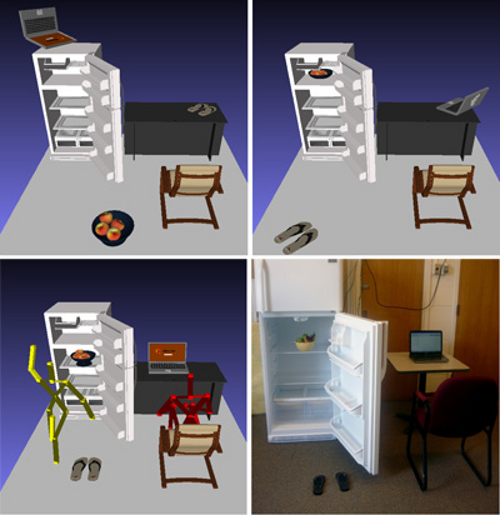
We are a long way from the kind of robotic intelligence that Asimov depicts in his stories, but interesting work out of Cornell University (thanks to Larry Klaes for the tip) points to the continued growth in that direction. At Cornell’s Personal Robotics Lab, researchers have been figuring out how to understand the relationship between people and the objects they use. Can a robot arrange a room in a way that would be optimal for humans? To make it possible, the robot would need to have a basic sense of how people relate to things like furniture and gadgets.
It should be easy enough for a robot to measure the distances between objects in a room and to arrange furniture, but people are clearly the wild card. What the Cornell researchers are doing is teaching the robots to imagine where people might stand or sit in a room so that they can arrange objects in ways that support human activity. Earlier work in this field was based on developing a model that showed the relationship between objects, but that didn’t factor in patterns of human use. A TV remote might always be near a TV, for example, but if a robot located it directly behind the set, the people in the room might have trouble finding it.
Here’s the gist of the idea as expressed in a Cornell news release:

Relating objects to humans not only avoids such mistakes but also makes computation easier, the researchers said, because each object is described in terms of its relationship to a small set of human poses, rather than to the long list of other objects in a scene. A computer learns these relationships by observing 3-D images of rooms with objects in them, in which it imagines human figures, placing them in practical relationships with objects and furniture. You don’t put a sitting person where there is no chair. You can put a sitting person on top of a bookcase, but there are no objects there for the person to use, so that’s ignored. The computer calculates the distance of objects from various parts of the imagined human figures, and notes the orientation of the objects.


Image: Above left, random placing of objects in a scene puts food on the floor, shoes on the desk and a laptop teetering on the top of the fridge. Considering the relationships between objects (upper right) is better, but the laptop is facing away from a potential user and the food higher than most humans would like. Adding human context (lower left) makes things more accessible. Lower right: how an actual robot carried it out. Credit: Personal Robotics Lab.
The goal is for the robot to learn constants of human behavior, thus figuring out how humans use space. The work involves images of various household spaces like living rooms and kitchens, with the robots programmed to move things around within those spaces using a variety of different algorithms. In general, factoring in human context made the placements more accurate than working just with the relationships between objects, but the best results came from combining human context with object-to-object programming, as shown in the above image.
We’re a long way from Asimov’s Three Laws, not to mention the brooding AI of the Greg Bear novel. But it’s fascinating to watch the techniques of robotic programming emerge because what Cornell is doing is probing how robots and humans will ultimately interact. These issues are no more than curiosities at the moment, but as we learn to work with smarter machines — including those that begin to develop a sense of personal awareness — we’re going to be asking the same kind of questions Asimov and Campbell did way back in the 1940s, when robots seemed like the wildest of science fiction but visionary writers were already imagining their consequences.
tzf_img_post


Public Spaces

Public Spaces:

Erik D. Martin

Erik D. Martin:
Erik D. Martin

Erik D. Martin is a visual development artist based in Los Angeles and currently working for Disney Interactive.
His past clients include Nickelodeon Animation, Hasbro Animation, Disney Imagineering and Jim Henson, among others, He also contributed work as a color artists on Kazu Kbuishi’s beautiful Amulet graphic novel project.
Martin has the kind of springy, energetic style often characteristic of the best concept art, with lively drawing underpinning an effective use of controlled color. I particularly like the way he handles atmospheric perspective in his landscape environments.
On his website, you can find galleries of his work divided into categories like Environments, Visual Development, Character Design and Sketches. Don’t miss the Props gallery, which is more interesting than you might suspect (images above, second from bottom). There is also a section for Storyboards and Sketches. (Avoid the “Client Portfolio” section; it leads to a login page that is hard to back out of.)
Martin Also maintains a blog where he posts both professional and personal work, including some plein air paintings (above, bottom).
Martin has conducted an online class in Digital Painting for the Computer Graphics Master Academy, which is still available (for the CGMA’s usual fee).
There is a small Erik Martin gallery on the Creative Talent Network (where you can also find links to many more talented concept and visual development artists).

Charles Courtney Curran (update)

Charles Courtney Curran (update):
Charles Courtney Curran

When I wrote about the lyrical paintings of Charles Courtney Curran back in 2007 I mentioned being disappointed at the small amount of his work available on the web.
Since then the web has continued to expand, bless it’s silicon heart, and more resources for Curran’s idyllic scenes of women in gardens, hanging clothes and surrounded by flowers, as well as his scenes of children playing and domestic activity, have be come available.
Notably, Matthew D. Innis has an extensive and eclectic post on his blog Underpaintings that gives a nice overview of Curran’s work, though the images are not large. For that, look to the Metropolitan Museum of Art’s superb high resolution reproduction of Curran’s portrait of Betty Newell (above, top with detail), as well as some of the zoomable images among Christies past auction lots.
I’ve listed other resources below. For more, see my previous post on Charles Courtney Curran.
[Thanks to TimM for the suggestion.]

House of the Week 145: Manhattan Beach House

House of the Week 145: Manhattan Beach House:

This near 3,000 ft2 home designed by design-build practice Walker Workshop sits on a tight infill lot on Manhattan Beach. The massing of the house responds to the local zoning, views to San Gabriel Mountains and the programmatic needs of the clients. The exterior finish of cement plaster and cedar siding flow to inside of the central stair and circulation space.

Uses of a Forgotten Cluster

Uses of a Forgotten Cluster:
Astronomical surprises can emerge close to home, close in terms of light years and close in terms of time. Take NGC 6774, an open cluster of stars also known as Ruprecht 147 in the direction of Sagittarius. In astronomical terms, it’s close enough — at 800 to 1000 light years — to be a target for binoculars in the skies of late summer. In chronological terms, the cluster has had a kind of re-birth in our astronomy. John Herschel identified it in 1830, calling it ‘a very large straggling space full of loose stars’ and including it in the General Catalog of astronomical objects.
But NGC 6774 remained little studied, and it took a more intensive look by Jaroslav Ruprecht in the 1960s to give the cluster both a new name and a firmer identity. This loose group of stars had long been thought to be an asterism, a chance alignment of stars that when seen from the Earth gave the impression of being a cluster. Ruprecht realized this was no asterism, and now new work with the MMT telescope in Arizona and the Canada-France-Hawaii Telescope on Mauna Kea is telling us that this cluster is, at about 2.5 billion years old, about half the age of the Sun. In fact, it’s about the age the Sun was when multicellular life began to emerge on our planet’s surface.

Image: Penn State University astronomers have determined that 80 of the stars in this photo are members of the long-known but underappreciated star cluster Ruprecht 147. In this image, the brightest of these stars are circled in green, and the less-bright ones are circled in red. These stars were born out of the same cloud of gas and dust approximately 2-billion years ago, and now are traveling together through space, bound by the force of gravity. The astronomers have identified this cluster as a potentially important new reference gauge for fundamental stellar astrophysics. Credit: Chris Beckett and Stefano Meneguolo, Royal Astronomical Society of Canada. Annotations by Jason Curtis, Penn State University.
Jason Wright (Penn State University) has been working on NGC 6774 with graduate student Jason Curtis, who will present the new findings in an upcoming conference in Barcelona, the 17th Cambridge Workshop on Cool Stars, Stellar Systems, and the Sun. Wright sees the significance of the cluster in terms of exoplanets and the stars that host them:
“The Ruprecht 147 cluster is very unusual and very important astrophysically because it is close to Earth and its stars are closer to the Sun’s age than those in all the other nearby clusters. For the first time, we now have a useful laboratory in which to search for and study bright stars that are of similar mass and also of similar age as the Sun. When we discover planets around Sun-like and lower-mass stars, we will be able to interpret how old those stars are by comparing them to the stars in this cluster.”
Most of the other nearby clusters are much younger than the Sun, making such comparisons less helpful, and it is work of Wright’s team that has demonstrated the cluster’s age as well as distance from Sol. These observations take in the directions and velocities of the stars in the cluster, showing that they are indeed moving together through space and are not a random pattern in the sky. Thus far 100 stars have been identified as part of the cluster but as the project continues, more are expected to be found. All told, NGC 6774 may become what Wright calls “a standard gauge in fundamental stellar astrophysics,” a helpful measuring stick in our neighborhood that can help us tighten up our age estimates of Sun-like, low mass stars.
The NGC 6774 work has been submitted to the Astronomical Journal. This Penn State news release has more.
tzf_img_post

Nagai Hideyuki

Nagai Hideyuki:
Nagai Hideyuki

Japanese artist Nagai Hideyuki has created a fun series of drawings that span two sketchbooks propped at 90° to one another, and when viewed from the proper angle, give the illusion of continuous three dimensionality.
You can see a selection on his website and on his deviantART page.
There is a video on YouTube that gives a clearer picture of the relationship between the two sets of drawings.
[Via Visual News by way of Colossal and io9]

Eye Candy for Today: Ingres portrait

Eye Candy for Today: Ingres portrait:
Comtesse d'Haussonville, by Jean-August-Dominique Ingres

Following up on my recent Eye Candy post about an Ingres graphite portrait, I couldn’t help but think of this well known and beautiful portrait painting.
Comtesse d’Haussonville, by Jean-August-Dominique Ingres, on Google Art Project. Use controls at lower right to zoom in.
Note the way he has carefully handled the reflection of the back of her head in the mirror and the attention given the incidental objects in the room.
Here is the painting on the site of the Frick Collection.

D Eleinne Basa

D Eleinne Basa:
D Eleinne Basa

D Eleinne Basa is a painter from New Jersey whose landscapes and florals can range from refined, as in her large studio paintings, to nicely rough edged and painterly, as in her plain air paintings. Her approach likewise can vary from softly tonalist to more straightforwardly realist.
I was immediately impressed by Basa’s painting Fall’s Approach (above, top) a large (30×40″, 76x100cm) and striking work that I had a chance to see in person recently. It’s one of those paintings that invites you to walk into it, but simultaneously exhibits a painterly surface.
Her painting Afternoon Light (second down) was awarded first place in Plein Air Magazine’s 2012 Annual Plein Air Online Salon.
I particularly enjoy the way she works with the play of late evening or early morning light as it cuts across some of her compositions, revealing form and color in intermittent shafts.

Jess and Russ

Jess and Russ:
Jess and Russ: Josh Cochran, Christopher Silas Neal, Frank Stockton, Alex Eben Meyer, Sam Weber, Neil Swaab, Chris Buzelli, James Gulliver Hancock

OK, now this is how you do an online wedding invitation.
I can’t possibly do better in describing “Jess and Russ” than Scott McCloud did in his tweet this morning:
“Another day, another stunning, collaborative, parallax-scrolling, infinite canvas wedding invitation.”
Exactly.
Collaborative refers to the contributions that the couple, both designers, elicited from their friends — many of whom are apparently talented illustrators (and some of whom I’ve featured previously on Lines and Colors).
The “infinite canvas” refers to McCloud’s own long term experimentation with the capabilities of the web in presenting comics and other graphic material without limitations of dimension as in print.
In an infinite canvas presentation, separate panels, text blocks or other bits of content are tied together in directional continuity by lines, borders or other graphic connectors, in this case in a long vertical scroll (image above, top).
“Parallax scrolling” is a method of limited animation achieved by dividing HTML content into planes that are moved by different degrees when scrolling a page.
The images I’ve shown above are just to give you a glimpse of the surprising quality and variety of the illustrations the project encompasses, but they don’t give you any of the feeling of the effect of the parallax scrolling animation.
There is an About page that describes the project and gives contributor credits.
(Images above: Josh Cochran, Christopher Silas Neal, Frank Stockton, Alex Eben Meyer, Sam Weber, Neil Swaab, Chris Buzelli, James Gulliver Hancock)
[Via Scott McCloud]

“Frankenweenie” Trailer #2

“Frankenweenie” Trailer #2:
A newer trailer with footage we haven’t seen before for Tim Burton’s Frankenweenie. Between ParaNorman, Hotel Transylvania and this, it’s monsters, monsters, monsters… (and I mean that in a good way):


Cartoon Brew |
Permalink |
21 comments |
Post tags: ,

“Nest” By Michael Ruocco

“Nest” By Michael Ruocco:
Nest is a short and sweet piece of character animation by NYC-area animator Michael Ruocco. The animation displays unusually sharp timing, which might be expected of someone who curates the blog Smears, Multiples and Other Animation Gimmicks. Michael also deserves credit as the co-curator of my new blog 365 Days of Ward Kimball. A fount of animation knowledge and an animator of great promise—Ruocco is the real deal.

Cartoon Brew |
Permalink |
10 comments |
Post tags:

On the Boards : Kortrijk School

On the Boards : Kortrijk School:
A proposal for a school complex located in Kortrijk, Belgium next to the river Leie designed by Julien de Smedt Architects. The design envisions a functional educational complex embracing outdoor activities linking the park environment. The program includes a new building and a series of renovations and extensions adding up to 7,200m2.

Eye Candy for Today: Rubens and Brueghel

Eye Candy for Today: Rubens and Brueghel:
he Feast of Achelous</a>, by Peter Paul Rubens and Jan Brueghel the Elder”  /><br />
<a href=The Feast of Acheloüs, by Peter Paul Rubens and Jan Brueghel the Elder.
Rubens painted the figures, Brueghel the richly detailed setting.
A feast, indeed.
In the collection of the Metropolitan Museum of Art. Click on “Fullscreen” and zoom or download.

High Tech Bus Stop in Paris by Patrick Jouin

High Tech Bus Stop in Paris by Patrick Jouin:
French designer Patrick Jouin has shared with us his latest project for client JCDecaux – a high tech bus stop (free Wifi anyone?) situated at the corner of Boulevard Henry IV and Place de la Bastille in Paris. Jouin has collaborated with JCDecaux on urban furniture since 2007, most notably for Vélib, the public bicycle sharing system in Paris.

Jacob Slevin sums up NeoCon 2012

Jacob Slevin sums up NeoCon 2012:
I'm not an analyst nor economist, but my observations are as follows:

1. Private-sector construction as a percentage of total construction appears robust considering the state of our economy.

2. Without question, digital content consumption is no longer the future, but rather the present. More interesting, there are nearly more architects and designers consuming content on their mobile devices than in magazines.


Designer Pages' CEO Jacob Slevin summarizes this year's NeoCon for HuffPo with video coverage, interesting attendee demographic data, and some of his personal favorite stand-outs.

AllesWirdGut Wins Bauhaereprais for LUX - Place de l’Académie

AllesWirdGut Wins Bauhaereprais for LUX - Place de l’Académie:
Viennese architecture practice AllesWirdGut has just won the prestigious Luxembourg Bauhaereprais (builders award) in the category 'Space and Landscape Design.' At a festive gala this week, the firm was presented the award for its project LUX - Place de l'Académie, the architectural design on a former steel mill in Esch-sur-Alzette, Luxembourg.

Los Angeles Metro Approves Gruen/Grimshaw for Union Station Master Plan

Los Angeles Metro Approves Gruen/Grimshaw for Union Station Master Plan:
The Los Angeles County Metropolitan Transportation Authority (Metro) Board of Directors today approved LA-based Gruen Associates, in association with London's Grimshaw Architects, as the consultant team for the creation of a master plan for the historic Union Station and its surrounding 40 acres. Metro CEO Art Leahy was authorized by the board to execute a firm fixed price contract not to exceed $4,150,000.

Learn 3ds Max Or Go To Jail

Learn 3ds Max Or Go To Jail:

The Animation Project is a New York City-area program that uses computer animation as an art therapy tool for court-involved teenagers. The program, founded by animator Brian Austin, is part of the Center for Alternative Sentencing and Employment Services (CASES), which offer youths rehabilitation opportunities such as GED training as an alternative to incarceration. This article by Greg Condon in Social Work Today discusses the program’s aims and the surprising comfort level of teenagers with 3D software:
Although none of the group members had worked in 3D Max before, they are all computer savvy, much like most in their age group. It was this fact that ultimately drew Austin’s focus back to computer animation. In the span of 45 minutes, each group member has turned a square polygon into a house with a pitched roof and side garage. As [Karen] Gibbons says, “Video games, movies, and print media are probably the main art forms these young people have been exposed to. Media like pastels and paints would be unfamiliar.” The group will spend the next four weeks building assets in 3D Max developing their story. As the weeks progress, they will begin dividing duties: One person may build the characters while another builds the setting of a scene.
I’ve embedded one of the student shorts at the top of the post. More of their work can be seen on The Animation Project’s Facebook page.

Cartoon Brew |
Permalink |
6 comments |
Post tags: ,

“Shooby Shooby Do Yah!” by Czarek Kwaśny

“Shooby Shooby Do Yah!” by Czarek Kwaśny:
Polish animator/artist Czarek Kwaśny plays with “Synthetic Cubism” in this lively musical piece. The whole thing is symbolic of the circle of life – or so he explains on his blog. Personally, I just think its a lot of fun.

Cartoon Brew |
Permalink |
3 comments |
Post tags:

“Saving Sally” trailer

“Saving Sally” trailer:
This looks absolutely terrific. Saving Sally is a tiny independent Filipino feature film by Avid Liongoren that combines actors, 2d animations, matte paintings & motion graphics. It’s two years into production with editing, post and additional animation to come. Can’t wait to see the finished project.
(Thanks, Ivan Guerrero)

Cartoon Brew |
Permalink |
5 comments |
Post tags: , ,

Abandoned Farm House Turned Into Life-Size Dollhouse

Abandoned Farm House Turned Into Life-Size Dollhouse:
This is an abandoned farm house that artist Heather Benning turned into a human-sized dollhouse (provided a human-sized dollhouse is just a regular house with no wall on one side).

A great city taking shape, 'Open City: London, 1500-1700'

A great city taking shape, 'Open City: London, 1500-1700':
The exhibition’s curators...argue that during these two centuries, transformations took place in three major public arenas, “gathering places where people mixed for business, leisure and worship”: church, the theater and the market. And that those changes created an “open city.”


Edward Rothstein reviews 'Open City: London, 1500-1700' an exhibition currently on show at the Folger Shakespeare Library in Washington DC. The exhibit is on view through Sept. 30

“Invade All of the Humans” by Tom and Mark Perrett

“Invade All of the Humans” by Tom and Mark Perrett:
Invade All of the Humans is a test piece for personal project written and directed by London-based commercial filmmakers Tom and Mark Perrett. It’s about two obsolete and unhinged retro robot toys, Calculord 3 and Px Micron, with delusions of world domination. They run on four AA batteries. Here’s the sample:


Cartoon Brew |
Permalink |
8 comments |
Post tags:

Lifestyles of Animation Executives: Jeffrey Katzenberg

Lifestyles of Animation Executives: Jeffrey Katzenberg:

Jeffrey Katzenberg makes his second appearance in our Lifestyles of Animation Executives column. Unlike his Beverly Hills mansion that he built on a $35 million plot of land, this relatively modest ski-in, ski-out lodge in Deer Valley, Utah cost a mere $10 million to build. The 14,000-square-foot space includes six bedrooms, gym, stone fireplace, ski-prep room with boot warmers built into the walls, an indoor pool and hot tub, a wood sauna and a billiard room. It also includes a 75-inch 3-D-enabled Samsung television that Katzenberg flew in from Korea.
The home was built twenty years ago but has been continually updated. Its interior floor plan was designed by architect Charles Gwathmey in consultation with architect Rick Otto. “[My wife] Marilyn wanted to create a place where we could be a family and not have social obligations infringe on that time,” Katzenberg explained to the Wall Street Journal. “We designed the house to be the perfect family trap. When we vacation at the house, we literally eat breakfast, lunch and dinner together.”
Guests at the home have included Bill Clinton, Al Gore, Michael Jackson, reality-TV producer Mark Burnett, Tom Cruise and Cameron Diaz. The Wall Street Journal offers more photos and a video tour of the property, which you may as well watch since it’s unlikely that Jeffrey will be extending invites to Cartoon Brew readers anytime soon. But seriously, Mr. K, if you’re ever lonely and need a ski buddy, don’t hesitate to get in touch. I’ll even eat dinner with you, though breakfast and lunch seems a tad excessive.

(Photos by Chad Hurst of the Wall Street Journal)

Cartoon Brew |
Permalink |
10 comments |
Post tags: , , ,

Talkback: Seth MacFarlane’s “Ted”

Talkback: Seth MacFarlane’s “Ted”:

Ted, the live-action/CG combo by Family Guy creator Seth MacFarlane opens today. If you’ve seen the film, please share your thoughts. I’ll be seeing the film soon because I’m a serious animation critic and it’s my duty to see everything animated, and…oh, who am I kidding, it’s got Mila Kunis in it.

Everybody should know the drill by now. This talkback is only for those who have seen the film. If you haven’t seen the film, your comment goes bye-bye.

Cartoon Brew |
Permalink |
7 comments |
Post tags: ,

Helping you build beautiful, powerful, successful apps

Helping you build beautiful, powerful, successful apps:
[This post is by Billy Rutledge, Director of Developer Relations for Android. — Tim Bray]
Just in time for Google I/O next week, the Android Developers site is stepping into a new look that is streamlined, simplified, and refocused. A developer’s tasks fall into three baskets: Designing, developing, and distributing. We're trying to make developer.android.com's organization reflect this reality, shepherding you through the app development life cycle, from start to finish.

Design

Earlier this year, we launched Android Design, an online style guide which lays out the principles, building blocks, and patterns for excellence in Android user interfaces. It seems to be working; every day, we see more and more beautiful apps arriving in Google Play. At I/O, we’ll continue to talk design, kicking off with Android Design for Success, led by Matias Duarte.

Develop

An Android app should be fast, powerful and useful. With Android Training, one of the many parts of the Develop section that we continue to build out, we lay out best practices in a variety of framework topics to help you achieve those goals. If you’re at I/O and you’re interested in Android tools, be sure to start off your show with What’s new in Android Developers’ Tools.

Distribute

The most important piece of the piece of the puzzle is about getting your app in front of millions and millions of Android users on Google Play. That’s why we added a section on distributing your app — a peek into the world of publishing and promoting your app. Chris Yerga on the Play team will be kicking off our how-to sessions on distributing your with Android apps in Google Play.
This is just a small sample of the Android sessions at Google I/O, many of which will be live-streamed so you can follow along even if you can’t make it out to San Francisco. In the meantime, we hope you find the new Android Developer site much more useful as you build great apps.


Replying to User Reviews on Google Play

Replying to User Reviews on Google Play:
[This post is by Trevor Johns from the Android team — Tim Bray]
User reviews on Google Play are great for helping people discover quality apps and give feedback to developers and other potential app users. But what about when developers want to give feedback to their users? Sometimes a user just needs a helping hand, or perhaps a new feature has been added and the developer wants to share the good news.

That’s why we’re adding the ability for Google Play developers to respond to reviews from the Google Play Android Developer Console. Developers can gather additional information, provide guidance, and — perhaps most importantly — let users know when their feature requests have been implemented.
We’ll also notify the user who wrote the review via email that the developer has responded. Users can then contact the developer directly if additional followup is needed or update their review.
We’re releasing this feature today to those with a Top Developer badge (). And based on feedback from users and developers, we will offer it to additional Google Play developers in the future.
Conversations are meant to be two-sided, and facilitating discussion between developers and users will ultimately yield better apps, to the benefit of everyone.